Domain (taxonomy)
Highest taxonomic rank of all organisms.

Wikipedia / Wikimedia Commons
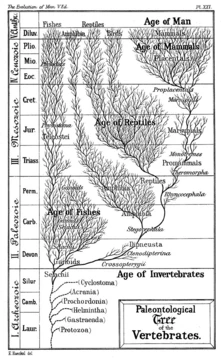
In biological taxonomy, a domain (also called a dominion, from Latin *regio* or *dominium*) is the broadest classification rank for all living organisms. This rank was introduced in 1990 by Carl Woese, Otto Kandler, and Mark Wheelis as part of their three-domain system. Depending on the model used, the tree of life is divided into either three domains—Archaea, Bacteria, and Eukarya—or two domains (Archaea and Bacteria), with Eukarya grouped within Archaea. Non-cellular life forms, especially viruses, are not covered by this system.
- introduced_by
- Carl Woese, Otto Kandler, Mark Wheelis
- year_introduced
- 1990
- highest_rank
- Yes
- domains_in_three_domain_system
- Archaea, Bacteria, Eukarya
- alternatives
- Two-empire system, eocyte hypothesis, five-dominion system
Lore & Background
The term domain was proposed by Carl Woese, Otto Kandler, and Mark Wheelis in 1990 in a three-domain system. Carl Linnaeus made the classification 'domain' popular in his taxonomy system in the middle of the eighteenth century, which was later improved by Charles Darwin but could not classify bacteria easily. The mycologist Royall T. Moore proposed the similar term dominion in 1974, with three dominions: Virus, Prokaryota, and Eukaryota, but this was not widely adopted.
Reader's Guide
The domain system represents a fundamental shift in biological classification, replacing the earlier two-empire system of Prokaryota and Eukaryota. Carl Woese's revolutionary breakthrough in 1977, comparing nucleotide sequences of 16s ribosomal RNA, revealed three branches instead of two. Initially, Archaea was not separated from Bacteria due to physical similarities, but scientists now know these two domains are distinctly different. Each domain contains unique ribosomal RNA, forming the basis of the three-domain system. The presence of a nuclear membrane differentiates Eukarya from Archaea and Bacteria, while Archaea and Bacteria differ in cell membrane biochemistry and RNA markers. Alternatives include the eocyte hypothesis, which places Eukarya within Archaea, and the five-dominion system proposed by Stefan Luketa in 2012, adding Prionobiota and Virusobiota.
Did You Know?
- The term domain was proposed by Carl Woese, Otto Kandler, and Mark Wheelis in 1990.
- Royall T. Moore proposed the similar term dominion in 1974, but it was not widely adopted.
- The three-domain system includes no form of non-cellular life, such as viruses.
- Stefan Luketa proposed a five-dominion system in 2012, adding Prionobiota and Virusobiota.
Frequently Asked Questions
What is a domain in biological taxonomy?
A domain is the topmost rank in the hierarchical classification of living organisms, sitting above kingdom and phylum. It was proposed in 1990 as a way to capture the deepest evolutionary splits among cellular life.
Who introduced the three-domain system?
The domain rank was proposed in 1990 by Carl Woese, Otto Kandler, and Mark Wheelis. Their framework reorganized the tree of life around fundamental differences in cellular and molecular biology.
What are the three domains of life?
In the classic three-domain model, all cellular organisms fall into Archaea, Bacteria, and Eukarya. Some alternative frameworks, like the eocyte hypothesis, collapse Eukarya into a subgroup of Archaea, leaving just two domains.
Do viruses belong to a domain?
No—viruses and other non-cellular entities are excluded from the domain system entirely. The three-domain scheme was designed specifically to classify organisms made of cells.
Is domain really the highest rank in taxonomy?
Yes, within the standard hierarchy, domain (sometimes called dominion) sits at the very top, above kingdom. A few alternative systems, such as the five-dominion or two-empire proposals, restructure things differently, but domain remains the most widely recognized top-level rank.
More in Taxonomy & Evolution 1-21
Spotted an error? Know more?
This is a living reference — every entry is fact-audited, and reader corrections feed straight into our audit queue. Suggest an edit · See this site's audit record