Kingdom (taxonomy)
Second highest taxonomic rank, below domain.
In biological classification, a kingdom is the second-highest taxonomic rank, sitting just below domain. Each kingdom is further split into smaller groups known as phyla. Carl Linnaeus first introduced this rank in 1735, making "kingdom" the top level, followed by class, order, genus, and species. Over time, more ranks were added, and in 1990 the domain rank was placed above kingdom.
A kingdom can be subdivided into subkingdom (subregnum) and infrakingdom (infraregnum). The term superkingdom may be used as a synonym for domain or empire, or as a separate rank between kingdom and domain. In some systems, an additional rank called branch (ramus) can appear between subkingdom and infrakingdom—for example, Protostomia and Deuterostomia in Cavalier-Smith’s classification.
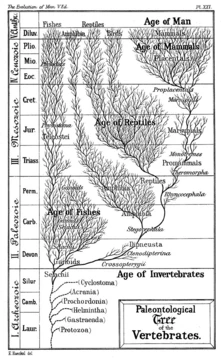
Historically, the division of life into animals and plants goes back to Aristotle and Theophrastus. Linnaeus formalized two kingdoms: Regnum Animale (animals) and Regnum Vegetabile (plants), and also included minerals in a third kingdom, Regnum Lapideum. After Antonie van Leeuwenhoek discovered microscopic single-celled organisms in 1674, these were initially placed within the animal and plant kingdoms. By the mid-19th century, this two-kingdom system was seen as outdated. In 1860, John Hogg proposed a third kingdom, Protoctista, for lower organisms, while keeping Regnum Lapideum. In 1866, Ernst Haeckel proposed another third kingdom, Protista, for organisms neither animal nor plant, and later divided life based on whether organisms were unicellular (Protista) or multicellular (animals and plants).
Microscopy later revealed a key difference between cells without a distinct nucleus (prokaryotes) and those with one (eukaryotes). Édouard Chatton introduced these terms in 1937. In 1938, Herbert Copeland created a four-kingdom system by adding Kingdom Monera for prokaryotes, which included what are now Bacteria and Archaea. In the 1960s, Roger Stanier and C. B. van Niel promoted the two-empire system (prokaryotes and eukaryotes), which later evolved into the three-domain system (Archaea, Bacteria, Eukaryota).
Robert Whittaker’s five-kingdom system, proposed in 1969, added Fungi as a separate kingdom based on nutrition: Plantae (multicellular autotrophs), Animalia (multicellular heterotrophs), Fungi (multicellular saprotrophs), plus Protista and Monera for unicellular and simple colonial forms. Th
- introduced_by
- Carl Linnaeus
- year_introduced
- 1735
- rank_position
- second highest, below domain
- subdivisions
- subkingdom, infrakingdom, branch
- alternative_terms
- superkingdom, empire, domain
Lore & Background
When Carl Linnaeus introduced the rank-based system of nomenclature into biology in 1735, the highest rank was given the name 'kingdom' and was followed by four other main or principal ranks: class, order, genus and species. Later two further main ranks were introduced, making the sequence kingdom, phylum or division, class, order, family, genus and species. In 1990, the rank of domain was introduced above kingdom. Prefixes can be added so subkingdom (subregnum) and infrakingdom (also known as infraregnum) are the two ranks immediately below kingdom. Superkingdom may be considered as an equivalent of domain or empire or as an independent rank between kingdom and domain or subdomain. In some classification systems the additional rank branch (Latin: ramus) can be inserted between subkingdom and infrakingdom.
Reader's Guide
The concept of kingdom has evolved significantly since Linnaeus first proposed two kingdoms: Regnum Animale and Regnum Vegetabile, with a third for minerals. Microscopy revealed microscopic organisms, leading to proposals for a third kingdom (Protoctista or Protista) in the 19th century. The development of microscopy distinguished prokaryotes from eukaryotes, leading to a four-kingdom system with Monera. Robert Whittaker's 1969 five-kingdom system (Animalia, Plantae, Fungi, Protista, Monera) became a popular standard, based mainly on differences in nutrition. In 1977, Carl Woese and colleagues proposed subdividing prokaryotes into Eubacteria and Archaebacteria based on ribosomal RNA structure, creating a six-kingdom model commonly used in recent US high school textbooks. Some recent classifications based on modern cladistics have explicitly abandoned the term kingdom, noting that some traditional kingdoms are not monophyletic. The terms flora, fauna, and funga are also used for life present in a particular region or time.
Did You Know?
- Carl Linnaeus introduced the rank 'kingdom' in 1735, originally including a third kingdom for minerals (Regnum Lapideum).
- In 1990, the rank of domain was introduced above kingdom.
- Some recent classifications based on modern cladistics have abandoned the term kingdom because some traditional kingdoms are not monophyletic.
- The terms flora, fauna, and funga are used for life present in a particular region or time.
Frequently Asked Questions
What is Kingdom in biological taxonomy?
A kingdom is the second-highest rank in the biological classification hierarchy, positioned directly beneath domain. It groups organisms into broad categories, each of which is then broken down further into phyla.
Who originally created the kingdom rank and when?
Carl Linnaeus introduced the kingdom rank back in 1735 as the very top level of his classification system. At that time it sat above class, order, genus, and species, before later revisions added domain above it in 1990.
Where exactly does kingdom sit in the taxonomic hierarchy?
Kingdom occupies the second-highest position, directly below domain. Below it, the hierarchy continues through subkingdom, infrakingdom, phylum, and the ranks beneath those.
What are the subdivisions of a kingdom?
A kingdom can be split into subkingdom (subregnum) and infrakingdom (infraregnum), and may also be divided into branches. The term superkingdom sometimes appears as a synonym for domain or empire, or as an intermediate rank between kingdom and domain.
Why is the kingdom rank important in evolutionary biology?
Kingdom provides the broadest meaningful grouping below domain, letting biologists organize the full diversity of life into manageable categories. Its position in the hierarchy reflects major evolutionary divergences, and its subdivisions help trace how lineages split from one another over deep time.
More in Taxonomy & Evolution 1-21
Spotted an error? Know more?
This is a living reference — every entry is fact-audited, and reader corrections feed straight into our audit queue. Suggest an edit · See this site's audit record