Fossil
Fossils are preserved remains of ancient life, key to evolution.

Wikipedia / Wikimedia Commons
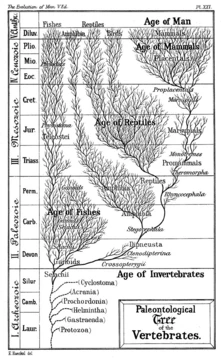
A fossil is any preserved remains, impression, or trace of a once-living thing from a past geological age, including bones, shells, exoskeletons, stone imprints, amber-preserved objects, hair, petrified wood, and DNA remnants. The totality of fossils is known as the fossil record, which, though incomplete, provides enough information to understand the pattern of diversification of life on Earth and can fill gaps in the sequence of evolution.
- definition
- Preserved remains, impression, or trace of any once-living thing from a past geological age
- minimum_age_for_fossil
- Over 10,000 years old
- oldest_fossils
- Approximately 3.48 billion to 4.1 billion years old
- largest_fossil
- Sequoia sp. measuring 88 m (289 ft) at Coaldale, Nevada
- field_of_study
- Paleontology
- key_processes
- Permineralization, casts and molds, authigenic mineralization, replacement and recrystallization, adpression, carbonization, bioimmuration
Lore & Background
Gathering fossils dates at least to the beginning of recorded history. Ancient civilizations interacted with fossils in various ways: Paleolithic peoples in Europe used fossil echinoderms as hand grips on stone knives and drilled holes in fossil shells for necklaces. The ancient Egyptians kept fossil bones resembling modern species in temples, and five-rayed fossil sea urchin shells were associated with the deity Sopdu. Greek scholar Aristotle recognized that fossil seashells from rocks were similar to those on beaches, indicating they were once living animals, while earlier Greek thinkers had explained them as vaporous exhalations. Roman naturalist Pliny the Elder wrote of 'tongue stones' (fossil shark teeth) and 'horns of Ammon' (fossil ammonites). In medieval China, fossil bones were mistaken for 'dragon bones' and used as medicine, and scholar Shen Kuo hypothesized that marine fossils in mountains indicated a prehistoric seashore that had shifted over centuries.
Reader's Guide
Fossils are central to paleontology, which studies their age, method of formation, and evolutionary significance. The observation in the 19th century that certain fossils were associated with specific rock strata led to the geological timescale and relative dating of fossils. The development of radiometric dating in the early 20th century allowed absolute age measurement of rocks and fossils. The fossil record remains a foundational source for understanding evolution and the history of life on Earth. Fossils vary enormously in size, from one-micrometre bacteria to dinosaurs and trees many meters long. They include body fossils (bones, shells) and trace fossils (tracks, coprolites), as well as chemofossils or biosignatures. Ancient and medieval cultures often incorporated fossils into mythology, such as Protoceratops skulls possibly inspiring griffin legends, or Deinotherium skulls being interpreted as Cyclopes. The study of fossils continues to refine knowledge of evolutionary patterns and Earth's history.
Did You Know?
- The oldest fossils are around 3.48 billion to 4.1 billion years old.
- The largest known fossil is a Sequoia sp. measuring 88 m (289 ft) in length at Coaldale, Nevada.
- Fossil shark teeth were called 'tongue stones' by Pliny the Elder and were thought by some classical cultures to look like tongues of people or snakes.
- In medieval China, fossil bones of ancient mammals including Homo erectus were often mistaken for 'dragon bones' and used as medicine and aphrodisiacs.
Frequently Asked Questions
What exactly counts as a fossil?
A fossil is any preserved remains, impression, or trace left behind by a once-living organism from a past geological age. This broad category covers everything from bones, shells, and exoskeletons to stone imprints, amber-encased insects, petrified wood, hair, and even surviving DNA fragments.
How old does a specimen need to be before it's officially considered a fossil?
The standard threshold is roughly 10,000 years old. Anything younger than that is generally classified as a subfossil rather than a true fossil.
What is the oldest fossil we know of?
The oldest known fossils date back approximately 3.48 to 4.1 billion years, making them among the earliest physical evidence of life on Earth.
What is the largest fossil ever discovered?
The record belongs to a Sequoia sp. specimen measuring 88 meters (289 feet) in length, found at Coaldale, Nevada.
What field studies fossils, and what processes turn ancient organisms into fossils?
Paleontology is the dedicated science of studying fossils and the fossil record. The main preservation mechanisms include permineralization, casts and molds, authigenic mineralization, replacement and recrystallization, adpression, carbonization, and bioimmuration.
More in Taxonomy & Evolution 1-21
Spotted an error? Know more?
This is a living reference — every entry is fact-audited, and reader corrections feed straight into our audit queue. Suggest an edit · See this site's audit record